A Practical Guide for Japanese Companies Considering Business Expansion into Türkiye
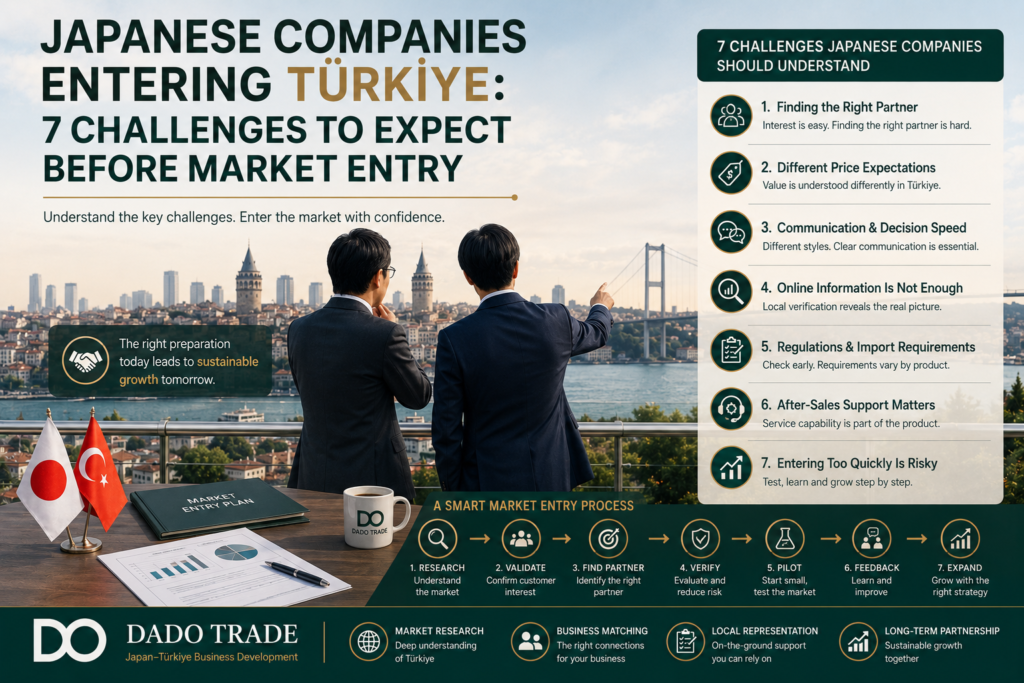
Türkiye can be an attractive market for Japanese companies looking to expand their international business. Its large industrial base, established manufacturing capabilities, growing technology sectors, and geographic position between Europe, the Middle East and Central Asia create opportunities across a wide range of industries.
However, entering Türkiye successfully requires more than finding a distributor or arranging several business meetings.
Japanese companies entering the Turkish market often encounter differences in pricing, communication, decision-making, distribution structures and customer expectations that may not be immediately visible from Japan.
Understanding these challenges before entering the market can significantly reduce risk and help companies develop a more realistic market entry strategy.
Here are seven issues Japanese companies should consider before starting business development activities in Türkiye.
1. Finding Interested Companies Is Easier Than Finding the Right Partner
One of the first objectives of many Japanese companies is to find a Turkish distributor.
A market search may quickly produce dozens of potential candidates. However, identifying companies that are genuinely suitable for long-term cooperation is much more difficult.
A potential partner should be evaluated according to factors such as:
- Existing customer network
- Industry specialization
- Technical capabilities
- Sales organization
- Competing brands in its portfolio
- Management commitment
- After-sales capabilities
- Financial and operational stability
Company size alone is rarely enough.
A smaller specialized distributor with strong relationships in your target industry may create significantly more value than a large distributor representing hundreds of products.
For this reason, distributor search should be treated as a partner selection process rather than a company-listing exercise.
2. Price Expectations May Be Very Different
Pricing is often one of the first challenges Japanese manufacturers encounter in Türkiye.
A product that is competitive in Japan or another developed market may face very different conditions in Türkiye due to:
- Local alternatives
- European and Asian competitors
- Import costs
- Currency movements
- Distributor margins
- Customer purchasing habits
This does not necessarily mean that a Japanese product is too expensive.
The more important question is whether Turkish customers understand and value the difference.
For technically advanced products, competing only on price is often the wrong strategy.
Instead, Japanese companies may need to demonstrate measurable value through factors such as:
- Longer product life
- Lower maintenance requirements
- Better performance
- Energy efficiency
- Production reliability
- Technical support
- Reduced total cost of ownership
Understanding the customer’s real purchasing criteria should therefore be part of market validation.
3. Communication and Decision-Making Can Move at a Different Speed
Japanese and Turkish companies can have noticeably different communication styles.
Japanese companies often prefer careful internal evaluation, detailed preparation and consensus before making major decisions.
Turkish companies may sometimes expect faster communication and quicker commercial responses.
Neither approach is inherently better.
The difficulty arises when each side interprets the other’s behavior according to its own business culture.
A Turkish company may interpret a long internal evaluation period as a lack of interest.
A Japanese company may interpret rapid decision-making or persistent follow-up as excessive pressure.
Clear communication about expectations, timelines and decision-making processes can prevent these misunderstandings.
A local partner familiar with both business cultures can be particularly valuable during this stage.
4. Market Information Available Online May Not Tell the Full Story
Market research has become dramatically easier.
Company databases, search engines, artificial intelligence and online trade platforms can identify competitors, distributors and potential customers within minutes.
But identifying a company is not the same as understanding it.
Important information often requires local verification:
- Is the distributor actually active in the target industry?
- How strong is its sales team?
- Which customers does it really serve?
- Does it have technical staff?
- Is management interested in developing a new product?
- How much attention would your brand receive?
- What do customers think about the company?
For this reason, desk research should normally be followed by direct market contact, interviews, meetings and, where appropriate, company visits.
Digital research creates the shortlist. Local verification helps make the decision.
5. Import and Regulatory Requirements Should Be Checked Early
Another common mistake is beginning commercial negotiations before confirming whether the product can be imported and sold under the intended conditions.
Requirements vary considerably depending on the product.
Depending on the industry, companies may need to consider:
- Product standards
- Technical conformity
- Certification
- Labelling
- Product safety requirements
- Customs classification
- Import controls
- Sector-specific regulations
Türkiye operates technical regulations and import inspection systems for a range of products, so regulatory requirements should be evaluated at an early stage rather than after a distributor has already been appointed.
For highly regulated or technical products, this question can influence the entire market entry model.
6. After-Sales Support Can Be as Important as the Product
This is particularly important for Japanese manufacturers of:
- Industrial machinery
- Automation equipment
- Agricultural technology
- Electronic systems
- Specialty materials
- Technical components
A Turkish customer may like the product but still hesitate to purchase it if there is uncertainty about what happens after the sale.
Typical questions include:
- Who will install the product?
- Who provides training?
- Where are spare parts available?
- Who responds if the equipment stops working?
- Is technical support available in Türkiye?
- How quickly can problems be solved?
This means distributor selection should not be based only on sales capability.
For many technical products, service capability is part of the product itself.
Sometimes the best market entry structure may therefore involve more than one partner—for example, a distributor supported by a technical service company or system integrator.
7. Entering the Market Too Quickly Can Be More Expensive Than Entering Slowly
When a market looks promising, companies naturally want to move quickly.
This can lead to decisions such as:
- Granting exclusivity too early
- Ordering excessive inventory
- Establishing a company before validating demand
- Selecting the first interested distributor
- Investing heavily in marketing before understanding customers
A phased approach can reduce these risks.
A practical market entry process may look like this:
Market Research → Customer Validation → Partner Search → Partner Verification → Pilot Project → Market Feedback → Expansion
For some companies, the first step may simply be sending samples and meeting several potential customers.
For others, it may involve appointing a non-exclusive distributor for a limited period.
For products suitable for direct consumer testing, limited imports or selected sales channels may provide valuable feedback before a larger investment.
The objective is not to enter the market as slowly as possible.
It is to make each investment decision based on information obtained from the previous stage.
Should Japanese Companies Establish a Company in Türkiye?
Not necessarily.
Foreign investors can establish companies in Türkiye, and international investors are generally able to establish company forms available under the Turkish Commercial Code.
However, the ability to establish a company does not mean it should always be the first step.
Depending on the product and strategy, companies may initially consider:
- A local distributor
- A commercial partner
- Local representation
- A pilot project
- Direct customer development
- A hybrid model
Once market demand has been demonstrated, establishing a local company may become a logical next stage.
The market entry structure should follow the business opportunity—not the other way around.
What Should Japanese Companies Do Before Entering Türkiye?
Before committing significant resources, we recommend answering five fundamental questions:
1. Is there genuine demand for the product?
Not theoretical demand—actual customer interest.
2. Who is the real customer?
The importer, distributor and end user may be completely different companies.
3. What type of partner is required?
A distributor is not always the answer. The right partner could be a system integrator, engineering company, OEM, specialized reseller or local representative.
4. Can the product compete commercially?
Evaluate the final market price, not only the export price.
5. What happens after the first sale?
Technical support, communication, inventory and customer service should be planned before market expansion.
How DADO Trade Supports Japanese Companies in Türkiye
DADO Trade supports Japanese companies throughout different stages of Turkish market development.
Depending on the project, our support may include:
- Turkish market research
- Competitor analysis
- Market validation
- Distributor search
- Business partner identification
- Partner screening and verification
- Customer identification
- Business matching
- Meeting coordination
- Factory and company visits
- Communication support
- Pilot market projects
- Local representation
- Long-term business development
Our approach is not based on simply providing a list of Turkish companies.
The objective is to understand the product, identify realistic market opportunities and connect Japanese companies with partners capable of developing sustainable business in Türkiye.
From Our Experience
One of the most important lessons in Japan–Türkiye business development is that interest and opportunity are not the same thing.
It is usually possible to find companies willing to attend a meeting or review a new product.
The more difficult task is determining whether there is a commercially sustainable opportunity—and whether the company sitting across the table is genuinely capable of developing it.
That requires research, direct communication and local verification.
For Japanese companies unfamiliar with Türkiye, spending more time on these steps before making a major commitment can substantially improve the quality of later decisions.
Conclusion
Türkiye offers meaningful opportunities for Japanese companies, but successful market entry requires more than finding a buyer.
Differences in pricing, business culture, distribution structures, regulations and customer expectations all influence the outcome.
Companies that validate the market first, carefully evaluate local partners and begin with a proportionate level of investment can reduce unnecessary risk while learning how the market actually works.
For Japanese manufacturers considering Türkiye, the first objective should therefore not be:
“How quickly can we enter?”
A better question is:
“What do we need to learn before we enter?”
That distinction can determine whether Türkiye becomes a short-term sales experiment or a sustainable long-term market.
Related Articles
- How to Validate the Turkish Market Before Investing
- How to Find the Right Business Partner in Türkiye
- How to Choose the Right Distributor in Türkiye
- Distributor or Establish a Local Company?
- How to Verify a Turkish Business Partner Before Signing an Agreement
- Why Japanese Companies Still Need a Local Partner in Türkiye in the AI Era