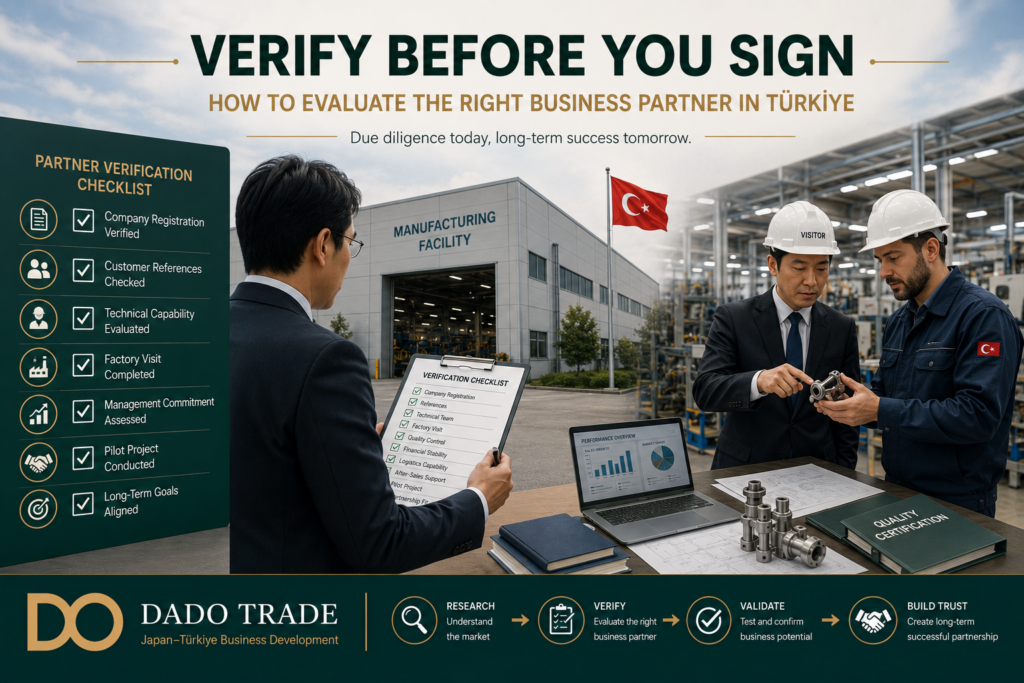
A Practical Due Diligence Guide for Japanese Companies
Choosing the right business partner is one of the most important decisions a company makes when entering a new market.
However, identifying a potential distributor or supplier is only the beginning.
Before signing any distribution agreement, supplier contract, or long-term cooperation agreement, companies should conduct a thorough verification process.
A professional due diligence process reduces commercial risk, prevents costly mistakes, and lays the foundation for successful long-term cooperation.
For Japanese companies entering Türkiye, partner verification should never be treated as a formality—it should be considered a strategic investment.
Why Online Research Is Not Enough
Today, almost every company has a professional website, active social media accounts, and attractive marketing materials.
Unfortunately, none of these guarantee that a company is the right business partner.
Important questions often remain unanswered:
- Does the company have real technical capabilities?
- How active is its sales organization?
- Does management truly support the project?
- Are customer relationships as strong as they appear?
- Can they provide reliable after-sales service?
These answers cannot be found through online research alone.
Step 1 – Verify Company Background
Before discussing commercial terms, confirm the company’s legal and operational status.
This includes:
- Company registration
- Years in operation
- Business activities
- Ownership structure
- Import and export experience
- Industry specialization
Understanding a company’s background helps determine whether it has the experience required for your products.
Step 2 – Visit the Office
An office visit reveals far more than a virtual meeting.
Observe:
- Company organization
- Team size
- Sales environment
- Communication style
- Management involvement
- Professionalism
Simple observations often provide valuable insights into how the company operates.
Step 3 – Visit the Factory or Warehouse
If the company manufactures products or maintains inventory, a site visit is highly recommended.
Evaluate:
- Production capability
- Quality systems
- Equipment
- Inventory management
- Cleanliness
- Safety standards
- Logistics operations
A factory visit often confirms whether a company can support long-term business growth.
Step 4 – Assess Technical Capability
For industrial products, technology solutions, and specialized equipment, technical competence is just as important as sales capability.
Ask questions such as:
- Can the technical team install the product?
- Do they provide training?
- Can they troubleshoot customer issues?
- Do they understand your technology?
Customers expect more than product delivery—they expect technical support.
Step 5 – Understand Their Customers
Rather than focusing only on company size, understand who their customers are.
Questions include:
- Which industries do they serve?
- Are they already working with similar products?
- Do they have experience with international manufacturers?
- Are they trusted within your target market?
Relevant customer relationships are often more valuable than a large sales organization.
Step 6 – Evaluate Management Commitment
Business partnerships succeed because people are committed—not because contracts are signed.
During meetings, observe:
- How engaged is senior management?
- Do they ask strategic questions?
- Are they interested in long-term cooperation?
- Do they understand your business objectives?
Strong management commitment usually leads to stronger partnerships.
Step 7 – Request Customer References
Whenever possible, ask for references.
Speaking with existing customers can provide valuable information about:
- Communication quality
- Reliability
- Technical support
- Delivery performance
- Problem-solving ability
Reference checks help confirm whether a company’s reputation matches its presentation.
Step 8 – Start with a Pilot Project
Rather than immediately signing an exclusive long-term agreement, many successful companies begin with a smaller project.
Examples include:
- Limited product imports
- Regional distribution
- Sample orders
- Joint customer visits
- Technical demonstrations
Pilot projects allow both companies to build trust while minimizing commercial risk.
Common Warning Signs
During partner verification, be cautious if you observe:
- Unrealistically optimistic sales forecasts.
- Limited technical knowledge.
- Poor communication.
- Frequent management changes.
- Lack of customer references.
- No clear business development strategy.
- Pressure to sign contracts quickly.
These warning signs do not necessarily indicate a poor company, but they deserve careful evaluation before making long-term commitments.
Opportunities for Turkish Companies
Verification is equally important for Turkish companies seeking Japanese manufacturers.
Before requesting exclusive distribution rights or beginning import activities, Turkish companies should evaluate:
- Product quality
- Manufacturing capacity
- Technical documentation
- Supply continuity
- Export experience
- Long-term cooperation philosophy
Successful partnerships require careful evaluation on both sides.
How DADO Trade Supports Partner Verification
DADO Trade helps Japanese and Turkish companies evaluate potential business partners through practical, on-the-ground verification.
Our services include:
- Company background research
- Distributor and supplier evaluation
- Office and factory visits
- Business partner screening
- Customer reference support
- Market validation
- Business meeting coordination
- Technical communication assistance
- Due diligence reporting
- Long-term business development support
Our objective is not simply to introduce companies.
Our objective is to help businesses make confident, informed decisions.
Partner Verification Checklist
Before signing an agreement, ask yourself:
☐ Company registration verified
☐ Business activities confirmed
☐ Office visited
☐ Factory or warehouse inspected
☐ Technical capability evaluated
☐ Customer references checked
☐ Management commitment assessed
☐ Pilot project completed
☐ Commercial expectations aligned
☐ Long-term growth potential confirmed
From Our Experience
One lesson consistently stands out in international business development.
The strongest partnerships are rarely built on impressive presentations or the fastest negotiations.
They are built on careful verification, transparent communication, and mutual trust.
Taking additional time before signing an agreement often saves months—or even years—of unnecessary challenges later.
In international business, trust is earned through preparation.
Conclusion
Choosing the right partner is not simply about finding a company willing to sell or distribute your products.
It is about identifying an organization that shares your commitment to quality, customer satisfaction, and long-term growth.
Companies that invest in proper partner verification are better positioned to build sustainable and successful business relationships in Türkiye.
Related Articles
- How to Validate the Turkish Market Before Investing
- How to Find the Right Business Partner in Türkiye
- How to Choose the Right Distributor in Türkiye
- Distributor or Establish a Local Company?
- Industrial Adhesive Market in Türkiye
- Agricultural Drone Market in Türkiye